Okay, I will write a detailed blog post about the AWS DevOps Agent and generate a realistic image to accompany it.
Prompt Expansion for Image:
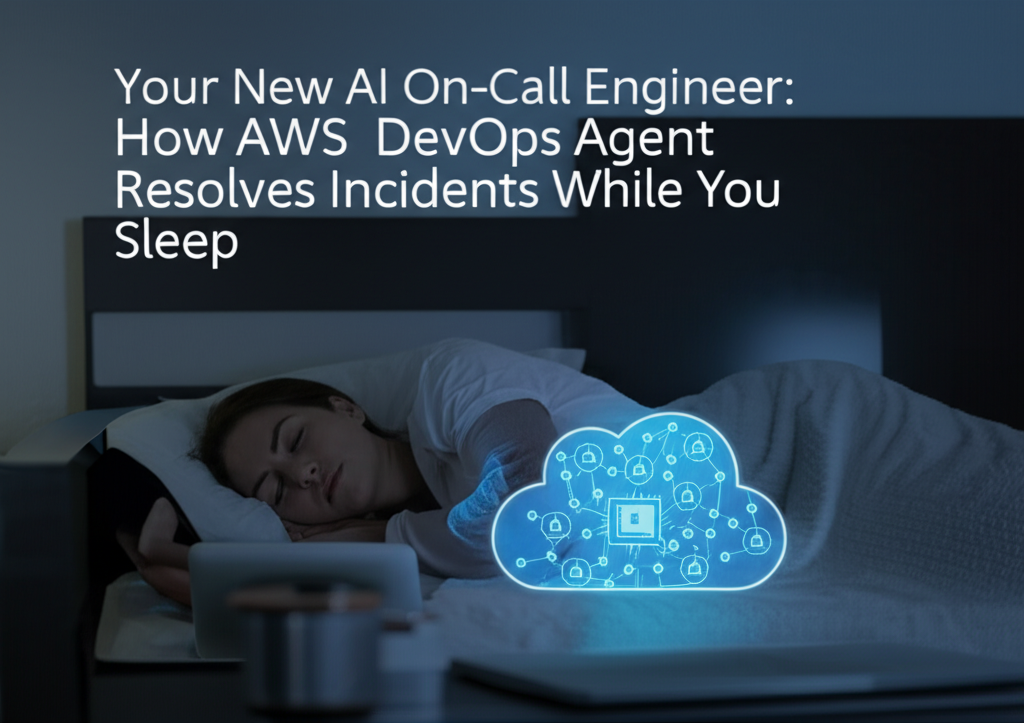
I will generate an image depicting a person sleeping peacefully in their bed at night, while in the background, a stylized representation of the AWS cloud with interconnected nodes and a subtle “DevOps Agent” icon actively monitoring and resolving alerts. The scene will convey the idea of automated incident resolution happening while the user is asleep.
Your New AI On-Call Engineer: How AWS DevOps Agent Resolves Incidents While You Sleep
Imagine this: it’s 3 AM. You’re sound asleep. Suddenly, your phone buzzes – an alert about a critical issue in your AWS environment. Panic sets in. You have to wake up, troubleshoot, and fix it. Sound familiar?
Well, what if you could sleep soundly knowing that an intelligent assistant is watching over your AWS infrastructure, ready to resolve issues automatically? That’s the promise of the AWS DevOps Agent.
In simple terms, the AWS DevOps Agent is like an AI-powered on-call engineer for your AWS services. It’s designed to detect, analyze, and even automatically fix common operational issues, all without human intervention. This means fewer sleepless nights and more time for you to focus on building amazing things.
Why Do We Need an AI On-Call Engineer?
Managing and monitoring modern cloud environments can be complex and time-consuming. Here’s why the DevOps Agent is a game-changer:
- Reduced Alert Fatigue: You get bombarded with alerts, many of which are minor or can be automatically resolved. The DevOps Agent filters out the noise and only escalates truly critical issues.
- Faster Incident Resolution: When an issue arises, the DevOps Agent can often identify the root cause and take corrective actions much faster than a human can, minimizing downtime.
- Improved System Stability: By proactively identifying and resolving issues, the DevOps Agent helps keep your applications and infrastructure running smoothly and reliably.
- Free Up Your Time: DevOps teams can spend less time on routine operational tasks and more time on strategic initiatives like innovation and development.
- Consistent Response: The DevOps Agent follows predefined rules and best practices, ensuring a consistent and reliable response to incidents every time.
How Does the AWS DevOps Agent Work?
Think of the DevOps Agent as having these key abilities:
- Observing: It continuously monitors your AWS resources (like EC2 instances, Lambda functions, databases, etc.) and logs for any unusual behavior or deviations from expected performance.
- Analyzing: When an anomaly is detected, the Agent uses machine learning and predefined playbooks to analyze the issue, identify the potential root cause, and understand its impact.
- Acting: Based on the analysis, the DevOps Agent can automatically take pre-configured actions to resolve the issue. This could involve restarting a service, scaling resources, or rolling back a deployment.
- Learning: Over time, the DevOps Agent learns from past incidents and resolutions, becoming even more effective at predicting and preventing future problems.
What Kind of Issues Can the DevOps Agent Handle?
While the capabilities will continue to expand, the AWS DevOps Agent can currently handle many common operational issues, such as:
- High CPU or Memory Utilization: Automatically scaling resources or restarting unresponsive instances.
- Application Errors: Rolling back faulty deployments or restarting application servers.
- Database Connection Issues: Attempting to re-establish connections or scaling database resources.
- Network Connectivity Problems: Diagnosing basic network issues and potentially reconfiguring security groups.
Getting Started with AWS DevOps Agent
The AWS DevOps Agent is designed to be easy to integrate with your existing AWS environment. Typically, you would:
- Define Monitoring Rules: Specify the metrics and logs you want the Agent to observe and the thresholds that trigger alerts.
- Configure Playbooks: Define the automated actions the Agent should take when specific types of issues are detected. These playbooks are essentially scripts or workflows that the Agent can execute.
- Integrate with Existing Tools: Connect the DevOps Agent with your existing monitoring and notification systems to ensure seamless information flow.
The Future of On-Call is Intelligent
The AWS DevOps Agent represents a significant step towards autonomous operations in the cloud. By leveraging the power of AI and automation, it can help you move away from reactive incident response to a more proactive and resilient approach to managing your AWS infrastructure.
So, the next time you lay your head down at night, you can rest a little easier knowing that your new AI on-call engineer is diligently watching over your systems, ready to handle whatever comes its way. This means fewer interruptions, more uptime, and ultimately, more peace of mind.