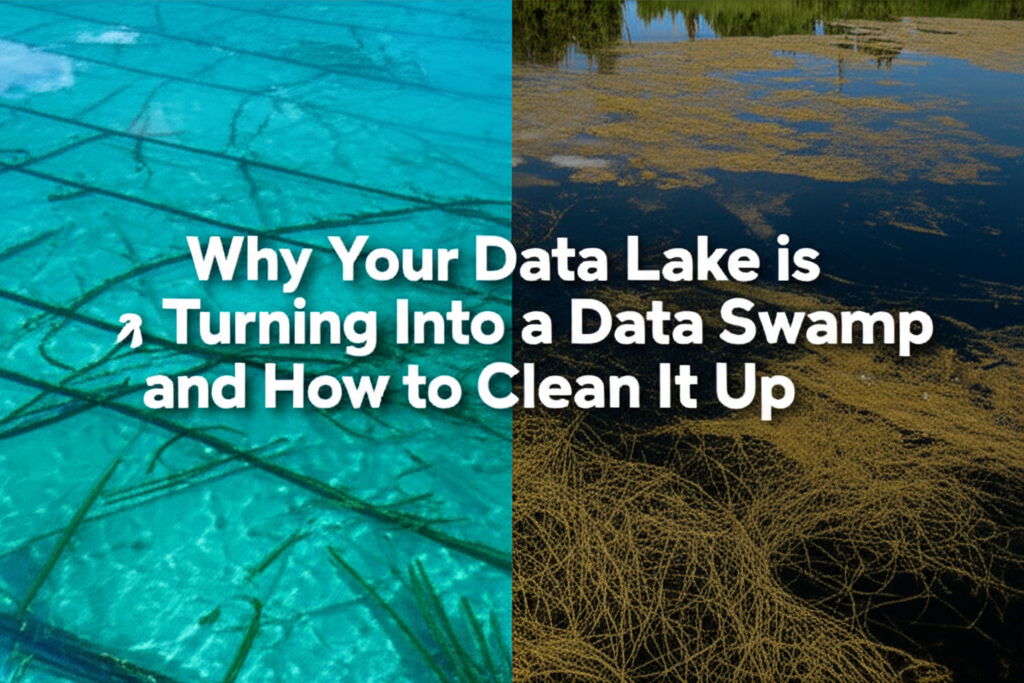
Why Your Data Lake is Turning Into a Data Swamp and How to Clean It Up
You built a data lake with high hopes. A central place to store all your data, no matter the format, ready for any kind of analysis. But lately, things feel… murky. Finding the right data is a struggle. Trusting the data is even harder. Congratulations, your data lake might be turning into a data swamp.
What’s the Difference Between a Data Lake and a Data Swamp?
Think of it this way:
- Data Lake: A well-maintained lake is clear and organized. You can easily see what’s in it and use it effectively. The water is clean, and the ecosystem is healthy.
- Data Swamp: A swamp, on the other hand, is murky and disorganized. It’s hard to see what’s beneath the surface. It might contain valuable resources, but finding and using them is a messy and inefficient process.
Why Does a Data Lake Turn Into a Swamp?
Several reasons can lead to this unfortunate transformation:
- Lack of Governance: This is the biggest culprit. Without clear rules and processes for how data is ingested, stored, and used, your lake can quickly become a dumping ground for anything and everything. Imagine letting anyone throw anything they want into a real lake – it wouldn’t stay clean for long.
- Poor Data Quality: If you’re constantly bringing in data without proper validation or cleaning, your lake will be full of errors, inconsistencies, and duplicates. Trying to get meaningful insights from low-quality data is like trying to drink dirty water – it’s not going to be helpful.
- Missing Metadata: Metadata is the “data about data.” It tells you what the data is, where it came from, when it was created, and how it should be used. Without good metadata, it’s like having a library with no catalog – you know the books are there, but you can’t find the one you need.
- No Clear Purpose or Use Cases: If you don’t define what you want to achieve with your data lake, it can become a collection of unused data. Without specific goals, there’s no incentive to organize or maintain the data effectively.
- Insufficient Skills and Tools: Managing a data lake requires the right skills and tools. If your team lacks expertise in data governance, data quality, and metadata management, or if you don’t have the necessary tools for these tasks, your lake is at risk.
How to Clean Up Your Data Swamp
Turning a swamp back into a lake takes effort, but it’s essential for getting value from your data. Here’s a practical approach:
- Establish Strong Data Governance:
- Define clear policies and procedures: Determine who is responsible for data ingestion, quality, security, and access.
- Implement data catalogs: Create a central repository for metadata, making it easy to discover and understand data assets. AWS Glue Data Catalog is a great option here.
- Define data standards: Set rules for data formats, naming conventions, and data quality.
- Improve Data Quality:
- Implement data validation processes: Check data for accuracy and consistency during ingestion. AWS DataBrew can help with this.
- Clean and transform existing data: Identify and fix errors, inconsistencies, and duplicates in your current data.
- Monitor data quality continuously: Set up alerts for data quality issues.
- Enrich Metadata:
- Automate metadata extraction: Use tools to automatically capture technical metadata. AWS Glue crawlers can do this.
- Encourage business users to add context: Add business-relevant metadata like data definitions, lineage, and usage notes.
- Make metadata searchable and accessible: Ensure users can easily find the information they need about the data.
- Focus on Use Cases:
- Identify key business problems: Understand what questions you need your data lake to answer.
- Prioritize data based on business value: Focus your cleanup efforts on the data that will provide the most impact.
- Develop clear data pipelines for specific use cases: Ensure data is processed and prepared in a way that meets the needs of the analysis.
- Invest in Skills and Tools:
- Train your team: Provide training on data governance, data quality, and relevant AWS services.
- Utilize the right AWS services: Leverage services like AWS Lake Formation for building, securing, and managing data lakes, AWS Glue for ETL (extract, transform, load) processes, and Amazon Athena or Amazon Redshift Spectrum for querying data.
Conclusion
A data lake has the potential to be a powerful asset for your organization, providing a foundation for advanced analytics and machine learning. However, without proper care and attention, it can easily devolve into a chaotic and unusable data swamp. By implementing strong data governance, focusing on data quality and metadata, aligning with business use cases, and leveraging the right AWS services, you can reclaim your data lake and unlock its true value. Don’t let your data drown in the swamp – take proactive steps to keep it clean and flowing.