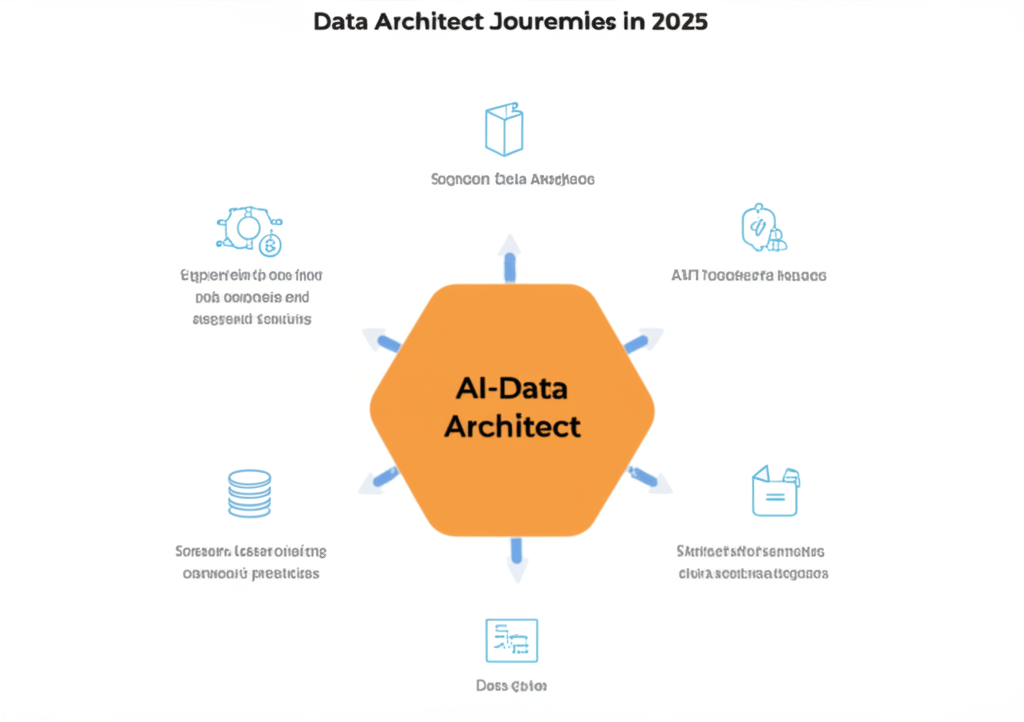
The Data Architect’s 2025 Roadmap: From Big Data to AI-Ready Data
The world of data is evolving at lightning speed. Just a few years ago, “Big Data” was the buzzword. Now, the focus is shifting towards making that data truly valuable – not just for reporting, but for powering Artificial Intelligence (AI) and Machine Learning (ML) initiatives. As a Data Architect, you’re on the front lines of this transformation. This roadmap will help you navigate the journey from managing vast amounts of data to building a future where your data is “AI-Ready.”
Think of it like upgrading your car. You might have a powerful engine (your Big Data infrastructure), but to win a race (deploy successful AI), you need more: better tires (data quality), a skilled driver (data governance), and a clear route (efficient pipelines).
What Does “AI-Ready Data” Actually Mean?
It’s more than just having a lot of data. AI-Ready data has key characteristics:
- High Quality: Clean, accurate, and consistent data. Noisy or incomplete data can lead to unreliable AI models.
- Well-Governed: Data is secure, compliant with regulations, and its lineage is clear. This builds trust and ensures responsible AI development.
- Easily Accessible: Data is discoverable and readily available to data scientists and ML engineers without unnecessary hurdles.
- Transformable: Data can be efficiently transformed and prepared into the specific formats required by different AI/ML algorithms.
- Scalable: The data infrastructure can handle the growing volume and velocity of data needed for training and deploying AI models.
The Data Architect’s Journey to AI-Readiness in 2025 (and Beyond):
Here’s a practical roadmap focusing on key AWS services:
Phase 1: Solidifying the Foundation (Now – 2024)
This phase is about optimizing your existing Big Data infrastructure and laying the groundwork for AI.
- Modernize Data Lakes with Amazon S3: Ensure your data lake is well-organized, scalable, and cost-effective. Leverage S3 Intelligent-Tiering for automatic cost optimization. Think about using AWS Lake Formation to centrally govern and secure your data lake.
- Enhance Data Integration with AWS Glue: Build robust and scalable ETL/ELT pipelines to ingest and transform data from various sources into your data lake. Explore Glue DataBrew for interactive data preparation.
- Improve Data Warehousing with Amazon Redshift: Optimize your data warehouse for analytical workloads. Consider using features like AQUA for faster query performance and Redshift ML for embedding machine learning directly within your SQL workflows.
- Implement Strong Data Governance: Establish clear policies for data access, security, and compliance. Leverage AWS services like AWS IAM, AWS KMS, and AWS Audit Manager. Implement data cataloging using AWS Glue Data Catalog to make data discoverable and understandable.
Phase 2: Building the AI Bridge (Mid 2024 – Early 2025)
This phase focuses on making your data more accessible and preparing it for AI/ML workflows.
- Democratize Data Access with Amazon Athena: Enable data scientists and analysts to easily query data directly in your S3 data lake using standard SQL.
- Explore Purpose-Built Databases: Understand when to use specialized databases like Amazon DynamoDB for high-performance NoSQL workloads, Amazon Neptune for graph databases (ideal for relationship analysis), or Amazon Timestream for time-series data (crucial for many AI applications like anomaly detection).
- Implement Data Quality Frameworks: Integrate data quality checks and monitoring into your data pipelines using services like AWS Deequ (an open-source library that works well with Glue and EMR).
- Focus on Feature Engineering: While data scientists will handle complex feature engineering, as a Data Architect, ensure your pipelines can efficiently support feature creation and storage. Consider using AWS Feature Store (currently in preview) to centralize and manage features for ML models.
Phase 3: Enabling AI/ML at Scale (Late 2025 and Beyond)
This is where your AI-Ready data truly shines.
- Seamless Integration with Amazon SageMaker: Ensure smooth data flow from your data lake and data warehouse into SageMaker for model training and deployment. Understand how SageMaker Data Wrangler can simplify data preparation for ML.
- Real-time Data Pipelines for AI: For applications requiring real-time AI (e.g., fraud detection, personalized recommendations), build streaming data pipelines using services like Amazon Kinesis Data Streams and integrate them with your ML models.
- MLOps Considerations: As AI models go into production, work closely with ML engineers to establish robust MLOps practices, including model monitoring, retraining, and versioning. Your data architecture needs to support these processes.
- Embrace Data Mesh Principles: For larger organizations, consider adopting a data mesh architecture where data ownership and responsibility are distributed to domain-specific teams. This can improve data quality and agility for AI initiatives.
Key Skills for the AI-Ready Data Architect:
- Deep Understanding of Data Modeling and Architecture Principles: This remains fundamental.
- Expertise in AWS Data and Analytics Services: Familiarity with S3, Glue, Redshift, Athena, DynamoDB, Kinesis, Lake Formation, and SageMaker is crucial.
- Knowledge of Data Governance and Security Best Practices: Ensuring data is secure and compliant is paramount.
- Understanding of Data Quality Concepts and Tools: Being able to implement and monitor data quality is essential for AI success.
- Collaboration and Communication Skills: Working effectively with data scientists, ML engineers, and business stakeholders is key.
- An Awareness of AI/ML Concepts: While you don’t need to be a machine learning expert, understanding the basics of how AI models consume data will inform your architectural decisions.
Conclusion:
The journey from Big Data to AI-Ready Data is an ongoing evolution. By focusing on data quality, governance, accessibility, and integration with AI/ML platforms like Amazon SageMaker, you, as a Data Architect, will be instrumental in driving innovation and unlocking the true potential of your organization’s data in 2025 and beyond. Embrace this roadmap, continuously learn, and be the architect of your data-driven future.