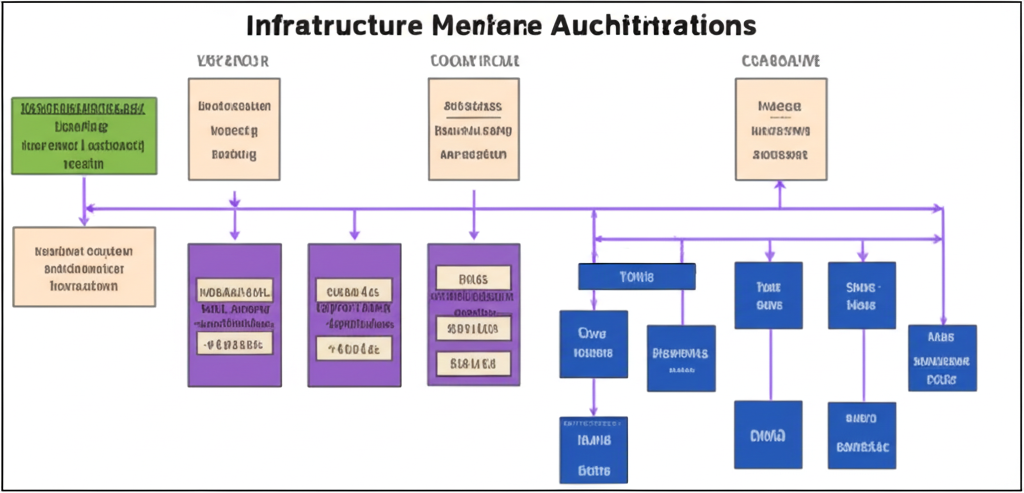
Scaling Up Your Automation: Infrastructure as Code Patterns for the Enterprise
For organizations operating at scale, managing infrastructure manually becomes a bottleneck, prone to errors and inconsistencies. Infrastructure as Code (IaC) offers a solution by treating your infrastructure like software, allowing for version control, repeatability, and automation. While the benefits are clear, implementing IaC effectively at an enterprise level requires adopting well-defined patterns.
This post explores five key IaC patterns that can help you achieve robust and scalable infrastructure automation on AWS. We’ll use simple language, relatable analogies, and practical examples to illustrate these concepts.
1. Modularization and Abstraction: The Building Block Approach
Analogy: Think of building with LEGO bricks. Instead of crafting every piece from scratch, you use pre-designed blocks (modules) that you can combine and reuse.
Concept: Modularization involves breaking down your infrastructure into reusable components or modules. This promotes consistency, reduces code duplication, and makes it easier to manage complex environments. Abstraction builds upon this by creating higher-level modules that hide the underlying implementation details.
Practical Example (Terraform):
Instead of defining an entire VPC with all its subnets, route tables, and security groups in a single file, you can create a reusable VPC module. This module can then be instantiated multiple times with different parameters for various environments (e.g., development, staging, production).
Use Case: Consistent deployment of standard infrastructure components across multiple teams or projects.
2. Environment Segregation: Creating Isolated Worlds
Analogy: Imagine having separate labs for different experiments. Each lab is isolated, preventing interference and ensuring the integrity of each experiment.
Concept: Environment segregation involves creating distinct and isolated AWS accounts or virtual environments (using VPCs and network controls) for different stages of your application lifecycle (e.g., development, testing, production). This minimizes the risk of unintended changes impacting critical production systems.
Practical Example: Maintaining separate AWS accounts for development, staging, and production environments. IaC pipelines can then be configured to deploy changes to the appropriate environment.
3. Pipeline-Driven Automation: The Continuous Delivery Highway
Analogy: Think of a factory assembly line. Each step is automated, ensuring a consistent and efficient production process.
Concept: Implementing IaC through CI/CD (Continuous Integration/Continuous Delivery) pipelines automates the process of infrastructure provisioning and updates. This provides version control, automated testing, and a streamlined deployment process.
Practical Example (AWS CodePipeline and CloudFormation):
- Developers commit IaC code (e.g., CloudFormation templates) to a Git repository.
- AWS CodePipeline detects the changes and triggers a build stage (optional, for tasks like linting or validation).
- A test stage deploys the changes to a non-production environment for automated testing.
- Upon successful testing, a production stage deploys the changes to the production environment, often requiring manual approval.
Use Case: Automating infrastructure deployments and updates with built-in governance and auditability.
4. Idempotency: Ensuring Consistent Outcomes
Analogy: Imagine a light switch. Flipping it on when it’s already on has no additional effect.
Concept: Idempotency in IaC means that applying the same configuration multiple times results in the same final state. This is crucial for reliable automation, as it ensures that subsequent runs of your IaC code don’t create unintended changes or errors.
Practical Example (CloudFormation):
When you apply a CloudFormation template, AWS compares the desired state defined in the template with the current state of your resources. It only makes the necessary changes to reach the desired state, without creating duplicates or causing conflicts if the resources already exist in the correct configuration.
5. Infrastructure Testing: Validating Your Foundations
Analogy: Before launching a bridge, engineers conduct rigorous tests to ensure its stability and safety.
Concept: Infrastructure testing involves validating that your provisioned infrastructure meets the desired specifications, security requirements, and performance expectations. This includes unit testing of modules, integration testing of components, and end-to-end testing of complete environments.
Practical Example (using tools like terratest with Terraform or writing custom scripts):
- Unit tests: Verify that individual Terraform modules create resources with the expected properties (e.g., an S3 bucket with encryption enabled).
- Integration tests: Ensure that different infrastructure components work together correctly (e.g., an EC2 instance can connect to an RDS database).
- End-to-end tests: Validate that the entire application stack functions as expected in a provisioned environment.
Key Takeaways:
- Modularization and Abstraction promote reusability and simplify complex infrastructure.
- Environment Segregation enhances stability and reduces the risk of impacting production systems.
- Pipeline-Driven Automation streamlines deployments and improves consistency.
- Idempotency ensures reliable and predictable infrastructure changes.
- Infrastructure Testing validates the correctness and reliability of your automated infrastructure.
By adopting these Infrastructure as Code patterns, enterprises can build scalable, reliable, and maintainable infrastructure automation on AWS, ultimately leading to faster deployments, reduced errors, and increased agility.