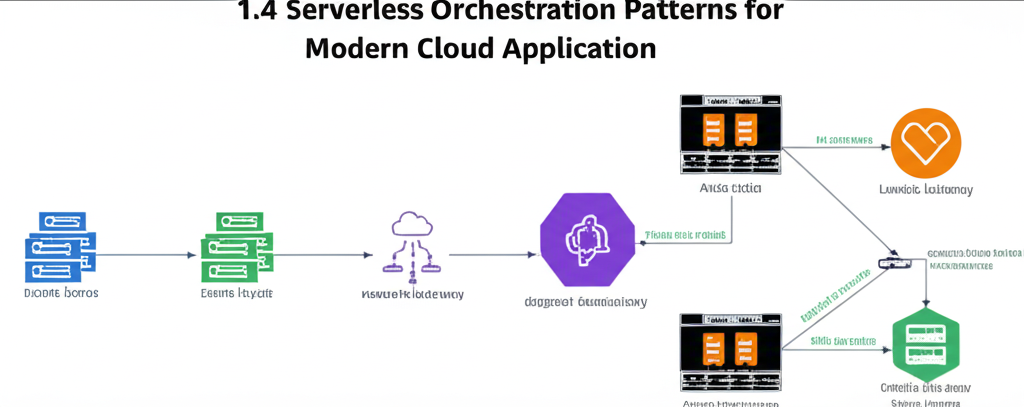
1.4 Serverless Orchestration Patterns for Modern Cloud Applications
Building complex applications in the cloud often involves breaking down monolithic systems into smaller, independent services. Serverless technologies, like AWS Lambda, API Gateway, and SQS, are ideal for creating these microservices. However, managing the interactions and workflows between these distributed components can become challenging. This is where serverless orchestration comes into play.
Think of serverless orchestration as the conductor of an orchestra. Each serverless service is a musician playing a different instrument. The conductor ensures they all play in harmony, following a defined score to achieve a beautiful symphony – your application’s desired outcome. Without orchestration, you might have a cacophony of services acting independently, leading to inefficiencies and difficulties in managing the overall application flow.
This post will explore key serverless orchestration patterns that can help you build robust and scalable modern cloud applications on AWS.
Why Orchestration Matters in Serverless Architectures
In a traditional monolithic application, the flow of execution is often linear and managed within a single codebase. In a serverless environment, a single user request or event might trigger a chain of events across multiple independent services. Orchestration provides a way to:
- Define and manage complex workflows: Clearly outline the steps and dependencies between different serverless functions.
- Ensure reliability and fault tolerance: Implement mechanisms for retries, error handling, and compensating transactions across services.
- Gain visibility and traceability: Monitor the execution flow and easily identify bottlenecks or failures.
- Promote loose coupling: Decouple individual services, making them easier to develop, deploy, and scale independently.
Key Serverless Orchestration Patterns
Here are some fundamental serverless orchestration patterns you can leverage:
1. Sequential Workflow:
- Analogy: Think of an assembly line. Each step must complete successfully before the next one can begin.
- Description: One service triggers another, and the output of one becomes the input of the next, in a linear fashion.
- Practical Example: Processing an e-commerce order. A Lambda function receives the order, then triggers another Lambda to validate inventory, followed by a third Lambda to process payment, and finally a fourth to send a confirmation email.
- Implementation: This can be achieved through direct synchronous invocations (though this can lead to tight coupling) or more robustly using services like AWS Step Functions.
-
- AWS Step Functions: Step Functions allows you to define state machines using JSON-based languages (AWS ASL or CDLK). Each state in the machine can represent a Lambda function invocation, a decision point, a parallel execution branch, or a wait period.

-
2. Parallel Processing:
- Analogy: Imagine a team of chefs working simultaneously on different parts of a meal to prepare it faster.
- Description: Multiple tasks or service invocations areexecuted concurrently to improve performance and reduce overall processing time.
- Practical Example: Processing a batch of images. An initial Lambda function can fan out and trigger multiple other Lambda functions to resize, watermark, and analyze each image in parallel.
- Implementation: AWS Step Functions offers “Parallel” states to execute multiple branches concurrently. You can also use services like AWS Batch or manage parallelism within a single Lambda function (though be mindful of concurrency limits).
-
- AWS Step Functions (Parallel State): The “Parallel” state allows you to define multiple branches of execution that run in parallel. Each branch can contain one or more steps.

-
3. Fan-Out/Fan-In:
- Analogy: Think of sending a broadcast message to multiple recipients (fan-out) and then collecting their individual responses (fan-in).
- Description: One event triggers multiple independent processes (fan-out), and then the results from these processes are aggregated or combined in a subsequent step (fan-in).
- Practical Example: Processing a large dataset. An initial Lambda function can split the data into smaller chunks and distribute them to multiple worker Lambdas (fan-out). Once all workers have processed their chunk, another Lambda function aggregates the results (fan-in).
- Implementation: AWS Step Functions, combined with services like Amazon SQS or SNS for message distribution, can effectively implement this pattern. You can use a “Map” state in Step Functions to dynamically iterate over a list and invoke a Lambda function for each item.
-
- AWS Step Functions (Map State): The “Map” state allows you to iterate over an array of items and execute a set of steps for each item.
-
4. Event-Driven Orchestration:
- Analogy: Imagine a network of sensors where an event detected by one sensor automatically triggers actions by other sensors or systems.
- Description: Services react to events emitted by other services. This promotes loose coupling and asynchronous communication.
- Practical Example: When a new file is uploaded to S3, it triggers a Lambda function to create a thumbnail, another to analyze its content, and a third to update a database.
- Implementation: AWS EventBridge is a powerful service for building event-driven architectures. It allows you to define rules that route events from various AWS services or custom applications to target services like Lambda functions, SQS queues, SNS topics, etc.
- AWS EventBridge: EventBridge acts as a central event bus, allowing services to publish and subscribe to events without direct dependencies.
5. Saga Pattern (for distributed transactions):
- Analogy: Think of coordinating multiple independent transactions across different bank accounts. If one transaction fails, you need to execute compensating transactions to rollback the changes made by the previous successful transactions.
- Description: A sequence of local transactions, where each transaction updates data within a single service. If one transaction fails, a series of compensating transactions are executed to undo the changes made by the preceding transactions, ensuring eventual consistency across services.
- Practical Example: In an e-commerce scenario, placing an order might involve: 1) Creating an order record, 2) Reserving inventory, and 3) Charging the customer. If charging fails, you need to compensate by releasing the reserved inventory and potentially canceling the order.
- Implementation: Implementing the Saga pattern in a serverless environment often involves using Step Functions to define the sequence of local transactions and their corresponding compensation functions.
- AWS Step Functions for Saga: Step Functions can manage the execution of local transactions and, in case of failure, trigger the appropriate compensating transactions.

Key Takeaways
- Serverless orchestration is crucial for managing complex workflows in modern cloud applications built with independent serverless services.
- Patterns like sequential workflow, parallel processing, fan-out/fan-in, and event-driven orchestration provide effective ways to coordinate serverless components.
- AWS Step Functions is a powerful service for implementing stateful workflows and managing the execution of multiple steps, including error handling and retries.
- AWS EventBridge enables event-driven orchestration by allowing services to react to events in a loosely coupled manner.
- The Saga pattern helps manage distributed transactions across multiple services by utilizing compensating transactions for rollback.
By understanding and applying these serverless orchestration patterns, you can build scalable, resilient, and maintainable cloud applications that leverage the full potential of serverless technologies. Remember to choose the pattern that best fits your specific use case and complexity requirements.