Event-Driven Mastery: Decoupling Your App with EventBridge and SQS
Building modern applications often means dealing with complex systems that need to talk to each other. Imagine an e-commerce site: when a customer places an order, the order service needs to notify the inventory service, the shipping service, and maybe even a marketing service to send a confirmation email. If these services are tightly coupled, meaning they directly communicate with each other, it can lead to problems:
- Failure Cascades: If one service goes down, it can break the entire order process.
- Scalability Issues: Scaling one service might require scaling others, even if they don’t need it.
- Slower Development: Changes in one service can require updates in others, slowing down development and deployment.
The solution? Decoupling your services. This means making them independent so that one service can function without direct knowledge of the others. One powerful way to achieve this on AWS is by using an event-driven architecture with Amazon EventBridge and Amazon Simple Queue Service (SQS).
Let’s break down how these services work together:
What is Event-Driven Architecture?
In an event-driven architecture, services communicate by emitting and reacting to events. An event is a change in state, like “OrderCreated” or “PaymentProcessed”. Instead of one service directly calling another, the first service publishes an event, and any other service interested in that event can subscribe to it and take action.
Enter Amazon EventBridge: Your Central Event Bus
Think of EventBridge as a central hub for all the events happening in your application and even across different AWS services and Software-as-a-Service (SaaS) applications.
- Event Producers: These are your application services that generate events.
- Event Bus: This is the central component in EventBridge that receives events.
- Rules: You define rules on the event bus to filter events based on their content and route them to one or more targets.
- Targets: These are the AWS services that will react to the events, such as AWS Lambda functions, SQS queues, SNS topics, and more.
Why is EventBridge So Useful for Decoupling?
- Loose Coupling: Services that produce events don’t need to know which services are consuming them. Consumers also don’t need to know the details of the producers.
- Simplified Integration: EventBridge makes it easy to connect different parts of your application and even integrate with third-party services.
- Extensibility: You can easily add new services to react to existing events without modifying the producers.
- Improved Reliability: If a target service is temporarily unavailable, the event remains in EventBridge (with the help of retry policies) until it can be delivered.
Amazon SQS: Ensuring Reliable Delivery
Amazon SQS is a fully managed message queuing service that allows you to decouple and scale microservices, distributed systems, and serverless applications. It acts as a buffer between services, ensuring that messages are not lost if a receiving service is busy or unavailable.
How SQS Complements EventBridge
While EventBridge routes events based on rules, SQS provides a reliable way to deliver and process those events asynchronously. Here’s how they often work together:
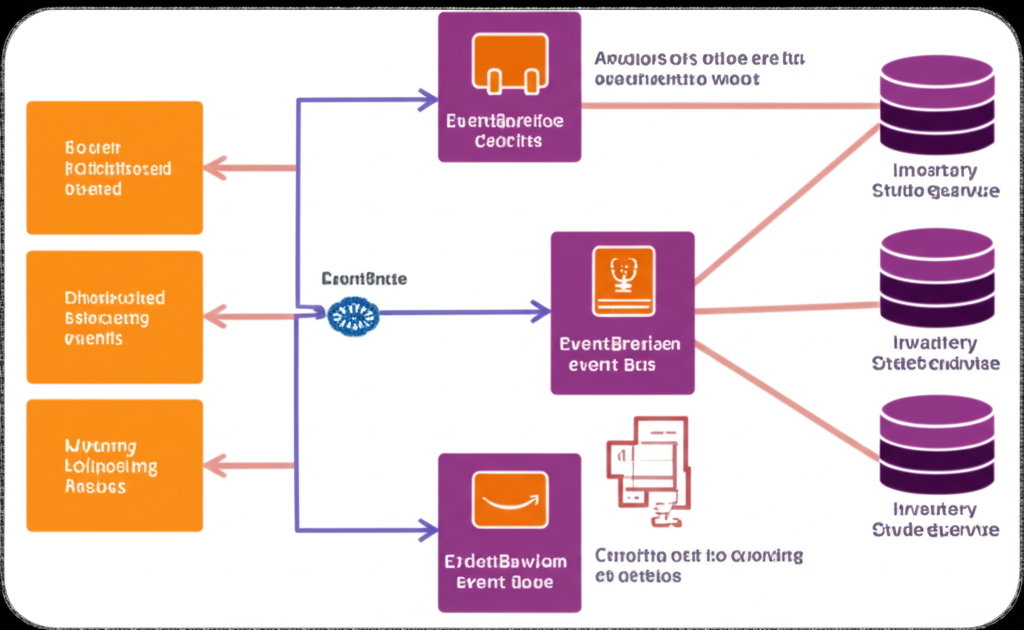
- An event is emitted by a service and reaches the EventBridge event bus.
- A rule in EventBridge matches the event and has an SQS queue as a target.
- EventBridge places the event (now a message) into the specified SQS queue.
- One or more consumer services can then poll the SQS queue and process the messages at their own pace.
Benefits of Using EventBridge and SQS Together:
- Increased Reliability: SQS ensures that events are delivered even if consumer services are temporarily down.
- Improved Scalability: Producers and consumers can scale independently. SQS acts as a buffer during traffic spikes.
- Fault Tolerance: If a consumer fails to process a message, it can be retried later (using features like dead-letter queues in SQS).
- Simplified Architecture: You can build more modular and maintainable applications by decoupling services.
A Simple Example:
Let’s revisit our e-commerce scenario.
- When a customer places an order, the Order Service emits an
OrderCreatedevent to EventBridge. - EventBridge has a rule that says: “If an event of type
OrderCreatedcomes in, send it to theInventoryQueueand theShippingQueueSQS queues.” - The Inventory Service polls the
InventoryQueue, receives theOrderCreatedevent (as a message), and updates the inventory. - The Shipping Service polls the
ShippingQueue, receives theOrderCreatedevent, and initiates the shipping process.
Notice that the Order Service doesn’t need to know anything about the Inventory or Shipping services. It simply emits an event. These other services react to the event independently.
Getting Started:
To start using EventBridge and SQS, you can explore the AWS Management Console, AWS CLI, or AWS SDKs. You’ll need to:
- Create an EventBridge event bus (the default bus is often sufficient for getting started).
- Create SQS queues that will act as targets for your events.
- Define rules on your EventBridge bus to route specific events to your SQS queues.
- Implement your application services to emit events to EventBridge and consume messages from SQS queues.
Conclusion:
Embracing an event-driven architecture with Amazon EventBridge and SQS is a powerful way to build resilient, scalable, and maintainable modern applications. By decoupling your services, you can improve fault tolerance, accelerate development, and create a more flexible and adaptable system. Start exploring these services today and unlock the benefits of event-driven mastery in your AWS environment!