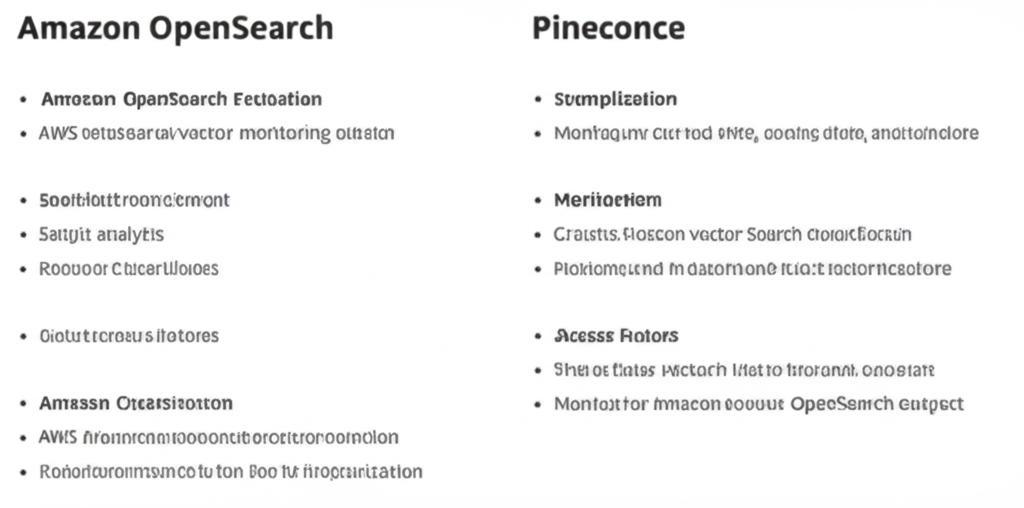
OpenSearch vs. Pinecone: Why AWS Might Be the Better Home for Your Vector Data
As AI and machine learning become more integrated into our applications, the need to efficiently search and analyze high-dimensional data, often represented as vectors, is skyrocketing. This has led to the rise of specialized vector databases. Two popular contenders in this space are Amazon OpenSearch Service and Pinecone.
While Pinecone is a fully managed vector database service, this post will explore why choosing Amazon OpenSearch Service within the AWS ecosystem might be the better long-term strategy for many users looking to manage and leverage their vector data.
Let’s break down the key advantages of sticking with AWS for your vector search needs.
1. Seamless Integration with the AWS Ecosystem
One of the most compelling reasons to consider OpenSearch is its native integration with the vast array of AWS services you might already be using. Think about it:
- Storage: Easily access data stored in Amazon S3.
- Compute: Leverage Amazon EC2 for your application servers and machine learning workloads.
- Data Pipelines: Integrate with AWS Glue for ETL processes and Amazon Kinesis for real-time data ingestion.
- Security: Benefit from AWS Identity and Access Management (IAM) for robust security and access control.
- Monitoring: Utilize Amazon CloudWatch for comprehensive logging and monitoring of your OpenSearch clusters.
This tight integration simplifies your architecture, reduces complexity, and often leads to better performance and lower latency due to data locality. Moving data between disparate platforms can be time-consuming, costly, and introduce potential points of failure.
2. Cost Efficiency and Predictability
While Pinecone offers a straightforward pricing model, leveraging OpenSearch within AWS can be more cost-effective for several reasons:
- No Separate Egress Fees: When your vector data and applications reside within AWS, you avoid data transfer (egress) fees that can accumulate when moving data between different cloud providers or services.
- Potential for Reserved Instances: AWS offers Reserved Instances for EC2 and OpenSearch instances, allowing you to significantly reduce costs for predictable workloads.
- Consolidated Billing: Manage all your AWS costs under a single bill, simplifying accounting and potentially qualifying for volume discounts.
- Granular Control Over Instance Types: You have fine-grained control over the instance types and scaling of your OpenSearch cluster, allowing you to optimize for both performance and cost.
While Pinecone’s managed nature has its convenience benefits, it can sometimes lack the granular cost control that AWS provides.
3. Flexibility and Customization
OpenSearch is a highly flexible and customizable platform built on the open-source Elasticsearch project. This gives you a significant advantage in tailoring your vector search solution to your specific needs:
- Choice of Deployment Options: Deploy OpenSearch in a fully managed AWS environment or opt for a self-managed approach on EC2 for greater control.
- Plugin Ecosystem: Extend OpenSearch’s functionality with a rich ecosystem of plugins for tasks like anomaly detection, alerting, and more.
- Advanced Search Capabilities: Beyond vector search, OpenSearch offers powerful full-text search, aggregations, and analytics capabilities, allowing you to combine different search methods for richer results.
- Scalability and Control: Scale your OpenSearch cluster up or down as needed with fine-grained control over resource allocation.
Pinecone, being a fully managed service, offers less control over the underlying infrastructure and customization options.
4. Security and Compliance
For organizations with stringent security and compliance requirements, AWS offers a robust and mature environment. OpenSearch inherits these benefits:
- Comprehensive Security Features: Leverage AWS security services like VPCs, security groups, encryption at rest and in transit, and integration with AWS KMS for key management.
- Compliance Certifications: AWS boasts a vast array of compliance certifications, helping you meet industry-specific and regulatory requirements.
- Fine-Grained Access Control: Use IAM to precisely control who has access to your OpenSearch data and operations.
While Pinecone also prioritizes security, organizations already invested in the AWS security framework may find it easier to maintain consistency and control by keeping their vector data within the same ecosystem.
5. Long-Term Strategic Alignment
Choosing AWS for your vector data aligns with a broader strategy of building your infrastructure on a comprehensive and mature cloud platform. This can lead to:
- Reduced Vendor Lock-in: While both options involve a degree of lock-in, relying on a major cloud provider like AWS can offer more flexibility and a larger ecosystem of tools and talent.
- Future Innovation: AWS continuously invests in its services, ensuring that OpenSearch will likely benefit from future advancements in vector search and related technologies.
- Consolidated Skill Sets: Your team likely already possesses skills in managing and operating AWS services, reducing the learning curve associated with adopting a new, standalone platform.
Conclusion: The Power of Integration
While Pinecone offers a specialized and convenient vector database solution, the seamless integration, cost efficiency, flexibility, robust security, and long-term strategic alignment of Amazon OpenSearch Service within the AWS ecosystem make it a compelling and potentially better choice for many users looking to harness the power of vector data.
By keeping your vector data close to your other AWS resources, you can simplify your architecture, optimize performance, reduce costs, and build a scalable and secure foundation for your AI and machine learning applications. Before making a decision, carefully evaluate your specific needs, existing infrastructure, and long-term goals to determine the best fit for your vector data journey.