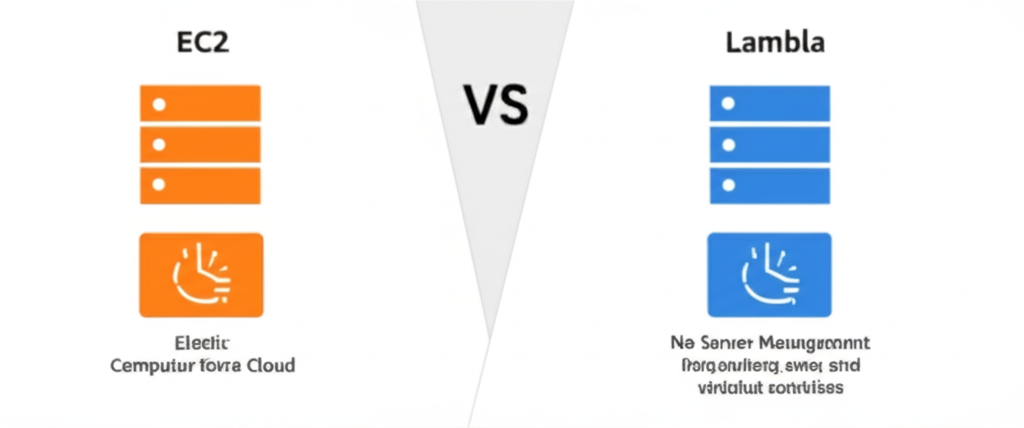
When you start building applications in the cloud with Amazon Web Services (AWS), you’ll quickly encounter two core services for running your code: EC2 (Elastic Compute Cloud) and Lambda. Both let you execute your applications, but they work in very different ways. Choosing the right one depends on your specific needs. Let’s break them down simply.
What is EC2? Think of it as Renting a Computer in the Cloud.
Imagine you need a computer to run your software. Instead of buying one and setting it up yourself, EC2 lets you rent a virtual computer (called an “instance”) from AWS. You get to choose the operating system (like Windows or Linux), the amount of processing power (CPU), memory (RAM), and storage you need.
Pros of EC2:
- Full Control: You have complete control over the operating system, installed software, and the environment your application runs in. This is great if your application has specific requirements.
- Long-Running Processes: EC2 instances can run continuously for as long as you need them. This is ideal for web servers, databases, or applications that are always online.
- Customization: You can customize every aspect of the server to perfectly match your application’s needs.
Cons of EC2:
- Management Overhead: You are responsible for managing the server, including patching, security updates, scaling (increasing or decreasing capacity), and monitoring. This takes time and effort.
- Cost When Idle: Even if your application isn’t doing much, you’re still paying for the server to be running.
- Scalability Challenges: Manually scaling your server capacity up or down during traffic spikes can be complex and time-consuming.
What is Lambda? Think of it as Just Running Your Code – No Server to Manage.
Lambda is different. Instead of renting a whole computer, you just upload your code to AWS, and Lambda takes care of running it for you. You don’t have to worry about servers, operating systems, or any of that infrastructure stuff. AWS automatically runs your code only when it’s needed and scales the resources automatically.
Pros of Lambda:
- No Server Management: AWS handles all the underlying infrastructure, so you can focus solely on writing your code.
- Pay-As-You-Go Pricing: You only pay when your code actually runs and for the exact amount of compute time it consumes (down to milliseconds). If your code isn’t running, you pay nothing.
- Automatic Scaling: Lambda automatically scales up or down based on the incoming requests. You don’t have to worry about handling traffic spikes.
- Event-Driven: Lambda functions are often triggered by events from other AWS services, like a file being uploaded to a storage service or a user clicking a button on your website.
Cons of Lambda:
- Limited Execution Time: Lambda functions have a maximum execution time (currently 15 minutes). This makes them unsuitable for very long-running processes.
- Stateless Nature: Lambda functions are typically stateless, meaning they don’t retain information between executions. You’ll need to use other services (like databases) to store persistent data.
- Cold Starts: The first time a Lambda function is invoked or after a period of inactivity, there might be a slight delay (called a “cold start”) as AWS sets up the environment. This can be a concern for latency-sensitive applications.
- Less Control: You have less control over the underlying environment compared to EC2.
So, When Should You Use EC2 vs. Lambda?
Here’s a simple guideline:
- Choose EC2 if:
- You need long-running processes (like web servers or databases).
- Your application has specific operating system or software dependencies that require full control.
- You need consistent performance and can tolerate some idle costs.
- You need full control over the server environment.
- Choose Lambda if:
- Your application logic can be broken down into short, independent functions.
- You have event-driven workloads (e.g., processing files, responding to API requests).
- You want to minimize operational overhead and focus on writing code.
- Cost optimization for low-usage periods is a priority.
- Automatic scaling is crucial.
In Simple Terms:
Think of EC2 as renting an apartment where you are responsible for everything (cleaning, maintenance, utilities). Lambda is like using a shared kitchen where someone else handles all the infrastructure, and you just pay for the time you use the oven.
Understanding the strengths and weaknesses of both EC2 and Lambda is fundamental to building efficient and cost-effective applications in the AWS cloud. Consider your application’s requirements carefully to make the right choice.