Navigating the Kubernetes Network Maze: Service Meshes and Ingress Controllers Explained
Kubernetes is fantastic for orchestrating containers, but when your application grows in complexity, so does its network. Managing how different parts of your application communicate internally and how external users access it can become a real challenge. Fear not! Kubernetes offers powerful tools like Service Meshes and Ingress Controllers to help you tame this network complexity.
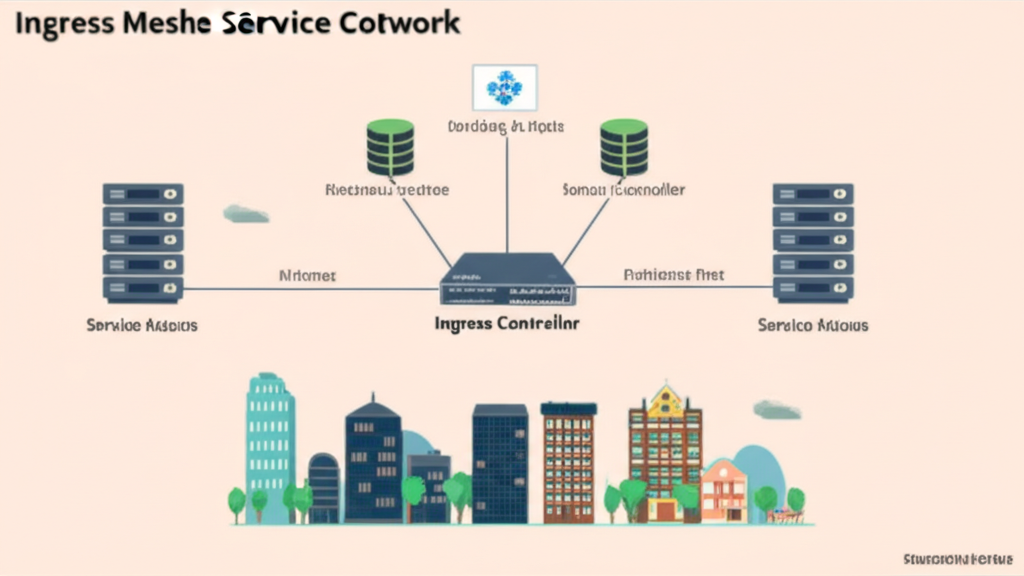
Think of your Kubernetes cluster as a bustling city. Your applications (pods) are like individual buildings, and they need efficient ways to communicate with each other and for visitors to reach them. This is where Service Meshes and Ingress Controllers come into play.
Let’s break down each concept:
1. Service Meshes: The Internal Communication Experts
Imagine your city needs a highly efficient and intelligent internal communication system for all its buildings. This system would handle things like:
- Secure communication: Ensuring conversations between buildings are private and authenticated.
- Traffic management: Directing internal traffic efficiently, maybe even rerouting it if a building is under construction.
- Observability: Providing detailed insights into how buildings are communicating, identifying any bottlenecks or issues.
This, in essence, is what a Service Mesh does for your Kubernetes cluster. It’s an infrastructure layer that sits alongside your application code, managing the communication between your microservices. It typically consists of two main components:
- Data Plane: This is made up of lightweight proxy containers (often using tools like Envoy) that are deployed alongside each of your application pods. These proxies intercept all network traffic to and from the pod.
- Control Plane: This is the brain of the service mesh. It manages the configuration of all the proxies in the data plane, enforcing policies and collecting telemetry data. Popular control planes include Istio and Linkerd.
Benefits of using a Service Mesh:
- Enhanced Security: Provides features like mutual TLS (mTLS) for strong service-to-service authentication and encryption without requiring changes to your application code.
- Improved Reliability: Offers features like automatic retries, circuit breaking, and timeouts to make your applications more resilient to failures.
- Better Observability: Provides rich metrics, logs, and traces about your service-to-service communication, making it easier to diagnose issues.
- Simplified Traffic Management: Allows you to implement sophisticated routing rules, A/B testing, and canary deployments without modifying your application code.
Think of it like this: Instead of each building having to manage its own security guards, traffic signals, and monitoring systems, the service mesh provides a centralized and consistent way to handle all of that for every building in the city.
2. Ingress Controllers: The Gatekeepers to Your Cluster
Now, let’s think about how external visitors get into our Kubernetes city. We need well-defined entry points and traffic management to guide them to the correct buildings. This is where Ingress Controllers come in.
An Ingress Controller acts as a reverse proxy and traffic router for your Kubernetes services. It sits at the edge of your cluster and manages external access to your applications based on rules you define in Ingress resources.
Key components:
- Ingress Controller: This is the actual application (often a reverse proxy like Nginx or HAProxy) running as a deployment in your cluster.
- Ingress Resource: This is a Kubernetes API object that defines the rules for routing external traffic to your services. These rules typically specify hostnames, paths, and the backend service and port to forward traffic to.
How it works:
- A user sends a request to your application (e.g.,
mywebsite.com/api). - This request first hits the Ingress Controller.
- The Ingress Controller looks at the Ingress resources you have defined.
- Based on the hostname (
mywebsite.com) and the path (/api), the Ingress Controller forwards the request to the appropriate service running in your cluster.
Benefits of using an Ingress Controller:
- Single Entry Point: Provides a single IP address and port for all your external traffic, simplifying external DNS management.
- Name-Based Virtual Hosting: Allows you to host multiple domains on the same IP address.
- Path-Based Routing: Enables you to route traffic to different services based on the URL path.
- TLS/SSL Termination: You can configure your Ingress Controller to handle SSL encryption and decryption, offloading this task from your application.
- Load Balancing: Many Ingress Controllers provide basic load balancing capabilities.
Imagine it as the city’s main gates and traffic police. They control who gets in and direct them to the right destination based on their address.
Service Mesh vs. Ingress Controller: What’s the Difference?
While both Service Meshes and Ingress Controllers deal with networking in Kubernetes, they operate at different layers and solve different problems:
- Ingress Controllers manage external access to your cluster, focusing on routing traffic from the outside world to your services.
- Service Meshes manage internal communication between services within your cluster, focusing on security, reliability, and observability of these interactions.
Can you use them together? Absolutely! In fact, they complement each other very well. You can use an Ingress Controller to handle external traffic and then rely on a Service Mesh to manage the communication between the internal microservices that handle those external requests.
Getting Started
If you’re just starting with Kubernetes networking, don’t feel overwhelmed. Here are a few steps you can take:
- Understand Kubernetes Services: Make sure you have a solid grasp of how Kubernetes Services work as they are the foundation for both Ingress and Service Meshes.
- Explore Ingress Controllers: Start by setting up a basic Ingress Controller (like Nginx Ingress) in your cluster and defining simple Ingress rules to expose your applications.
- Investigate Service Meshes: Once you’re comfortable with Ingress, consider exploring a service mesh like Linkerd (which is known for its simplicity) or Istio for more advanced features.
Conclusion
Advanced networking in Kubernetes with Service Meshes and Ingress Controllers might seem daunting at first, but they are powerful tools that can significantly improve the security, reliability, and manageability of your applications. By understanding their roles and how they work together, you can navigate the Kubernetes network maze with confidence and build more robust and scalable systems.