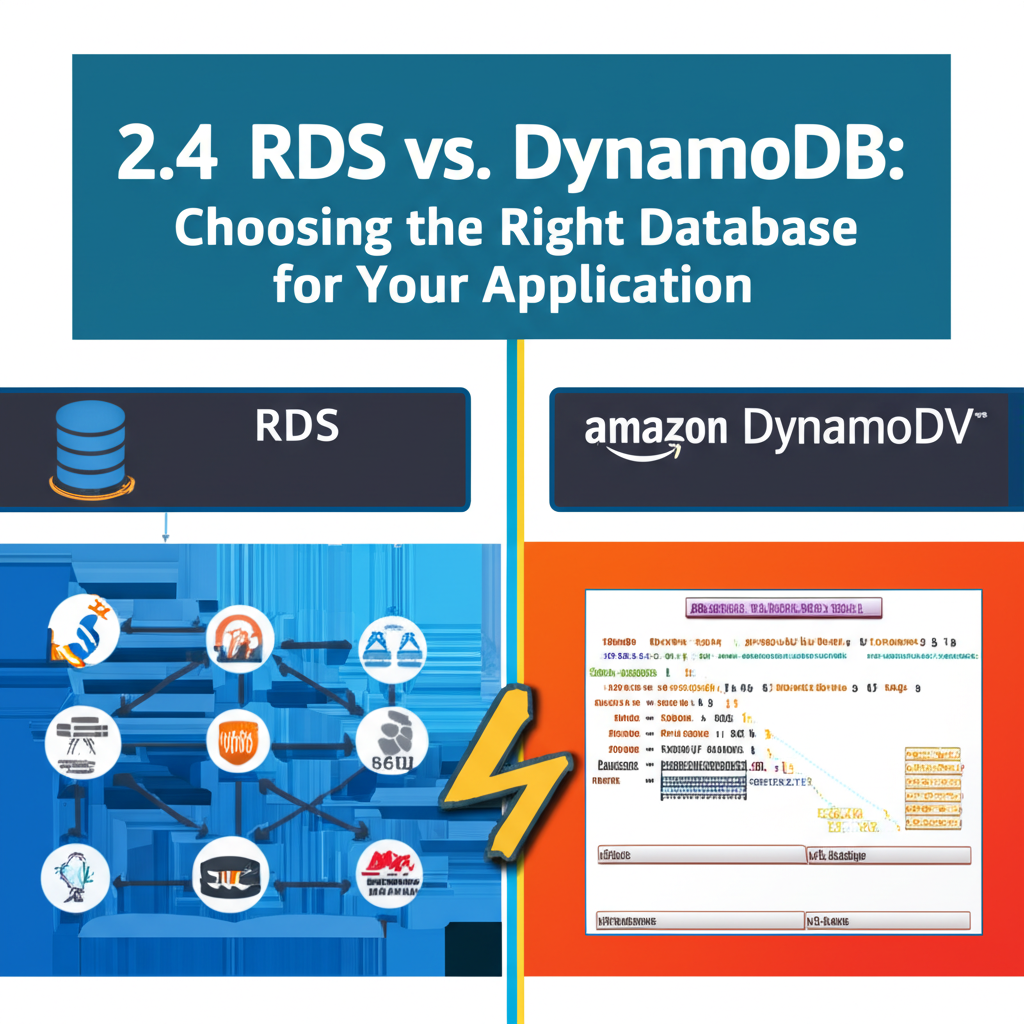
RDS vs. DynamoDB: Picking the Perfect Database for Your Application
So, you’re building an application and need a database. You’re on AWS, which is fantastic! But now you’re staring at a list of options, including RDS and DynamoDB. Which one do you choose? Don’t worry, this post will break down the differences between RDS and DynamoDB in plain English, so you can make the best choice for your needs.
Think of databases as specialized filing cabinets. They store and organize data so you can easily retrieve it when you need it. RDS and DynamoDB are both powerful database services offered by AWS, but they work in fundamentally different ways. Understanding these differences is crucial for building a scalable, efficient, and cost-effective application.
RDS: Your Familiar and Reliable Relational Database
RDS (Relational Database Service) is like a well-organized filing cabinet with specific folders and drawers. It’s based on the familiar concept of relational databases, which use tables, rows, and columns to structure data. You likely already have experience with relational databases like MySQL, PostgreSQL, or SQL Server, and RDS allows you to leverage that knowledge.
Key characteristics of RDS:
- Structured Data: RDS thrives on structured data that fits neatly into tables with defined relationships. Think of user profiles (name, email, address), product catalogs (name, description, price), or order information (order ID, customer ID, product ID).
- SQL is Your Friend: You interact with RDS using SQL (Structured Query Language). SQL is a standard language for querying and manipulating data in relational databases.
- Scalability with Limits: RDS can scale vertically (increasing the size of your server) and horizontally (using read replicas to distribute read load). However, scaling often requires downtime and can be more complex compared to DynamoDB.
- ACID Compliance: RDS prioritizes ACID properties (Atomicity, Consistency, Isolation, Durability), ensuring data integrity and reliability. This is critical for applications requiring financial transactions or sensitive data handling.
- Good for Complex Queries: RDS excels at handling complex queries that involve joining multiple tables and performing aggregations.
When to Choose RDS:
- You need ACID compliance: For applications like banking, e-commerce transactions, or healthcare records.
- Your data is structured and relational: You have clear relationships between different data entities.
- You need complex queries and reporting: You need to analyze data across multiple tables.
- You are familiar with SQL and relational database concepts: Leveraging your existing skills can save time and effort.
DynamoDB: The NoSQL Powerhouse
DynamoDB is like a giant, flexible filing cabinet where you can store anything, almost without predefined structure. It’s a NoSQL (Not Only SQL) database, meaning it doesn’t rely on traditional tables and relationships. Instead, it uses key-value pairs and documents, offering more flexibility in how you store and retrieve data.
Key characteristics of DynamoDB:
- Flexible Data Model: DynamoDB can handle structured, semi-structured, and even unstructured data. You can store JSON documents, images, or any other type of data.
- NoSQL – Say Goodbye to Joins (Mostly): You don’t use SQL with DynamoDB. Instead, you use specific DynamoDB APIs for reading, writing, and querying data. This means you generally avoid complex joins.
- Extreme Scalability: DynamoDB is designed for massive scale. It can handle virtually unlimited amounts of data and traffic, automatically scaling to meet your demands without downtime.
- Eventually Consistent (Mostly): DynamoDB offers different consistency models. While it can provide strong consistency for individual items, achieving strong consistency across all data often comes with performance trade-offs. You need to design your application accordingly.
- Speed and Efficiency: DynamoDB is incredibly fast at retrieving data based on its primary key.
When to Choose DynamoDB:
- You need extreme scalability and performance: For applications with millions of users or high-velocity data.
- Your data is unstructured or semi-structured: You don’t need to define a rigid schema upfront.
- You need simple key-based lookups: You primarily need to retrieve data based on its unique key.
- You are building a mobile app, gaming platform, or IoT application: These types of applications often require the scalability and performance that DynamoDB offers.
Here’s a Quick Comparison Table:
| Feature | RDS | DynamoDB |
|---|---|---|
| Data Model | Relational (Tables, Rows, Columns) | Key-Value, Document |
| Query Language | SQL | DynamoDB APIs |
| Scalability | Vertical & Horizontal (with limits) | Virtually Unlimited, Automatic |
| Consistency | ACID Compliant | Eventually Consistent (options for strong) |
| Data Structure | Structured | Flexible (Structured, Semi, Unstructured) |
| Use Cases | Transactions, Complex Queries | High-Scale, Simple Lookups |
| Pricing | Based on Instance Size & Storage | Based on Throughput & Storage |
Making the Right Choice:
Choosing between RDS and DynamoDB is all about understanding your application’s requirements. Consider these questions:
- What kind of data will you be storing? Structured or unstructured?
- How much data will you be storing, and how quickly will it grow?
- What kind of queries will you be running? Simple lookups or complex joins?
- How important is data consistency?
- What is your budget?
Sometimes, the answer isn’t either/or. You might even use both RDS and DynamoDB in the same application, leveraging their strengths for different parts of your system.
Example:
Imagine you’re building an e-commerce platform.
- You might use RDS to store product catalogs, user accounts, and order information, because these require structured data, ACID compliance, and complex queries for reporting.
- You might use DynamoDB to store shopping cart data, session information, or user activity logs, because these require high scalability and fast key-based lookups.
Conclusion:
RDS and DynamoDB are powerful tools in the AWS database arsenal. By understanding their strengths and weaknesses, you can choose the right database for your application and build a scalable, efficient, and cost-effective solution. Don’t be afraid to experiment and test different approaches to find what works best for your specific needs! Good luck!